
Trees
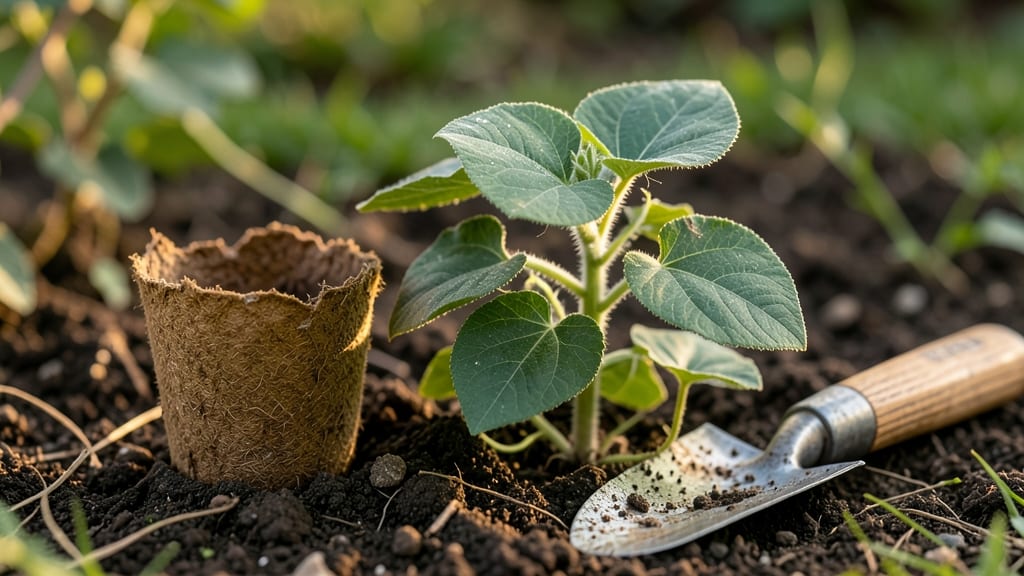
Mastering moonflower seedling identification early ensures you won’t confuse them with morning glories or other vines—just look for those first heart-shaped leaves and clockwise-twining stems. 🌿 I’ve pulled up enough lookalikes to recognize these clues instantly now.
Moonflower seedlings start with two rounded lobes on each leaf, unlike morning glories’ jagged edges or sweet potato vines’ arrowhead shape. The stems are slender but woody at the base by the time they’re a few inches tall, and they’ll climb anything within reach.
If you see these traits, you’ve got the real deal.
Once confirmed, handle them gently—they’re tender. Transplant when they’re 3-4 inches tall, keeping the soil moist but not soggy. They’ll reward you with silvery-white blooms that open at dusk, smelling like sweet honey. That first bloom is the payoff for spotting them early.
For beginners, mark their location with a stake until you’re sure—mistakes happen. And if you’re growing them in containers, choose 5-gallon pots for their sprawling habit. The secret to success? Patience and paying attention to those first leaves.
📚 In This Guide
- What you need
- Instructions
- Tips and common mistakes
- Wrapping up and next steps
What you need
- ● Moonflower seedlings – At least 2-3 young plants (for comparison and accuracy).
- ● Grow light or natural sunlight – A bright, indirect light source (e.g., a 10,000-lux LED grow light or a south-facing window).
- ● Magnifying glass – A 2x-5x handheld magnifier to inspect leaf details and fine structures.
- ● Ruler or measuring tape – For measuring leaf size and stem thickness (preferably in inches or centimeters).
- ● Notebook or digital device – To record observations (leaf shape, vein patterns, stem texture, etc.).
- ○ Camera (optional but helpful) – A smartphone or digital camera to capture close-ups of leaves, stems, and growth patterns.
- ● Pruning shears or scissors – Small, sharp tools for gently trimming leaves or stems if needed for closer inspection.
- ● Plant identification app – Apps like PlantNet or iNaturalist to cross-reference your findings.
- ● Field guidebook – A local flora guidebook for visual comparisons (e.g., National Audubon Society Field Guide to North American Wildflowers).
- ● Moisture meter – To check soil moisture levels if seedlings appear stressed.
- ● Gloves – Lightweight gardening gloves to protect hands from prickly stems or sap.
- ● Label markers and tags – For labeling seedlings if you’re tracking multiple varieties.
Step-by-step guide to identifying moonflower seedlings
Here's how to spot those early-stage moonflowers before they bloom.
🌱 Step 1: Examine Leaf Shape for Distinctive Lobing
Moonflower seedlings develop deeply lobed leaves that resemble tiny maple leaves. Look for 3-5 rounded lobes on each leaflet, with the central lobe being the largest. These lobes create a hand-shaped silhouette when viewed from above—something you won't see in similar night-blooming plants.
The margins of moonflower leaves are slightly scalloped, not smooth or jagged. Run your fingers along the edge—you should feel gentle waves rather than sharp points. This texture becomes more pronounced as the plant matures, making it easier to distinguish from imposters like morning glories.
🌿 Step 2: Check Stem Characteristics for Hairy Texture
Moonflower stems are covered in fine, soft hairs that give them a velvety appearance when young. Run your thumb along the stem—you'll notice a slightly rough but silky sensation. This hairiness persists even as the plant grows, though it may become less noticeable as the plant matures.
The stems also exhibit zigzag growth patterns between leaf nodes, which is a key identifier. Unlike straight-stemmed vines, moonflower seedlings grow in gentle, angular bends that create a distinctive "S" shape when viewed from the side.
✂️ Step 3: Verify Growth Habit and Leaf Arrangement
Moonflower seedlings grow vining habit from the start, even at just a few inches tall. Look for alternate leaf arrangement where each new leaf emerges from a different point along the stem rather than directly opposite its predecessor. This pattern continues as the plant climbs.
The first true leaves (not the initial seed leaves) appear broad and heart-shaped with prominent veins radiating from the center. These leaves are slightly larger than the seed leaves and have a darker green color—a good way to confirm you're dealing with a moonflower rather than a lookalike.
💧 Step 4: Compare with Common Lookalikes
Moonflowers can be confused with morning glories, but there's one key difference: morning glory leaves are heart-shaped with smooth edges, while moonflower leaves have those distinct lobes. Hold a seedling up to a window—you should see the light create shadows that highlight the lobed structure.
Another trick is to check the leaf attachment. Moonflower leaves connect to the stem with a broad base, while morning glory leaves have a narrower attachment point. This subtle difference becomes more obvious as the plant grows.
Tips & tricks for perfect moonflower seedling identification
Took me years of gardening to notice these subtle details—here's what nobody tells you about confirming those elusive moonflower seedlings.
Leaf Lobing Detail: The key to spotting those 3-5 rounded lobes lies in examining the leaf from multiple angles. Hold the seedling up to a bright light source—you'll notice the shadows cast by the lobes create a distinct "handprint" pattern that's impossible to miss. This is especially helpful when comparing with morning glory seedlings, whose leaves appear almost perfectly smooth by comparison.
Stem Texture Test: Run your thumb along the stem and pay attention to the sensation. That velvety roughness is a dead giveaway—morning glory stems feel smoother, almost waxy in texture. The hairiness becomes more pronounced in morning light, so that's the best time to check this detail. I've caught many imposters this way when the leaves were still too small to tell.
Growth Pattern Insight: That zigzag pattern between leaf nodes isn't just random—it's a growth adaptation that creates more surface area for photosynthesis. Look closely at how the stem bends: true moonflowers make gentle, consistent S-curves, while other vines often have more abrupt angles. This becomes especially noticeable when the plant reaches about 6 inches in height.
Lighting Technique: Natural daylight is your best friend here. Place the seedling near a window with indirect sunlight and observe how the light passes through the leaves. Moonflower leaves will create intricate shadow patterns from those scalloped edges, while imposters will show more uniform light transmission. I've used this trick to confirm seedlings in my greenhouse when the leaves were still tiny.
Pro Tips for Moonflower Seedling Identification
- Took me years of gardening to notice these subtle details—here's what nobody tells you about confirming those elusive moonflower seedlings.
- Leaf Lobing Detail: The key to spotting those 3-5 rounded lobes lies in examining the leaf from multiple angles.
- Stem Texture Test: Run your thumb along the stem and pay attention to the sensation.
Frequently asked questions
Got questions about moonflower seedlings? You’re not alone!
Here are some of the most common queries—and their answers—to help you confidently identify and care for your young moonflower plants.
How do I tell a moonflower seedling apart from other vines or weeds?
Moonflower seedlings (Ipomoea alba) have heart-shaped leaves with a slightly pointed tip and a smooth, hairless stem. Early-stage seedlings may resemble morning glory or sweet potato vines, but moonflowers grow faster and develop silver-gray undersides on leaves as they mature. Pull up a suspect plant and check the roots—moonflowers have thin, fibrous roots, while weeds often have thick taproots.
When is the best time to transplant moonflower seedlings?
Transplant moonflower seedlings after the last frost when soil temperatures reach at least 60°F (15°C). They thrive in warm climates and can’t handle cold snaps. For faster growth, wait until they have 2–3 sets of true leaves (not just the initial seed leaves). Harden off seedlings by exposing them to outdoor conditions for 1–2 weeks before transplanting to avoid shock.
Can moonflower seedlings grow in containers, or do they need a garden?
Yes! Moonflowers adapt well to large containers (10+ gallons) with draining soil and support for their vines. Use a fast-draining potting mix and fertilize lightly every 4–6 weeks. Containers keep them manageable for patios or balconies, but they’ll need regular watering (let soil dry slightly between waterings) and a trellis or fence to climb.
Why are my moonflower seedlings wilting or turning yellow?
Wilting or yellowing often signals overwatering, poor drainage, or pests. Check the soil—moonflowers prefer it moist but not soggy. Yellow leaves can also mean nutrient deficiency (add a balanced fertilizer) or aphids (spray with soapy water). If stems feel mushy, root rot may be the culprit—repot in fresh, dry soil immediately.
Will moonflower seedlings bloom in their first year?
Moonflowers are fast growers but typically bloom in their first summer if planted early (after frost). Seedlings grown from seed may take 3–4 months to flower, while established plants produce large, fragrant white blooms at night. For quicker blooms, choose transplants (1–2 feet tall) from nurseries in early spring.
Wrapping up and next steps
Identifying moonflower seedlings is all about paying attention to those heart-shaped leaves and velvety stems—your secret weapons for success! 🌱 Now that you’re armed with the right knowledge, take that next step: plant with confidence and watch your moonflower thrive.
Whether you’re nurturing a new garden or troubleshooting an unknown plant, you’ve got this!
🌟 Ready to Grow?
- Transplant your confirmed seedlings into well-draining soil.
- Monitor their progress and enjoy the blooms (and maybe even the moonlit magic!) soon.